
What a "600x slower corrosion" headline actually measured
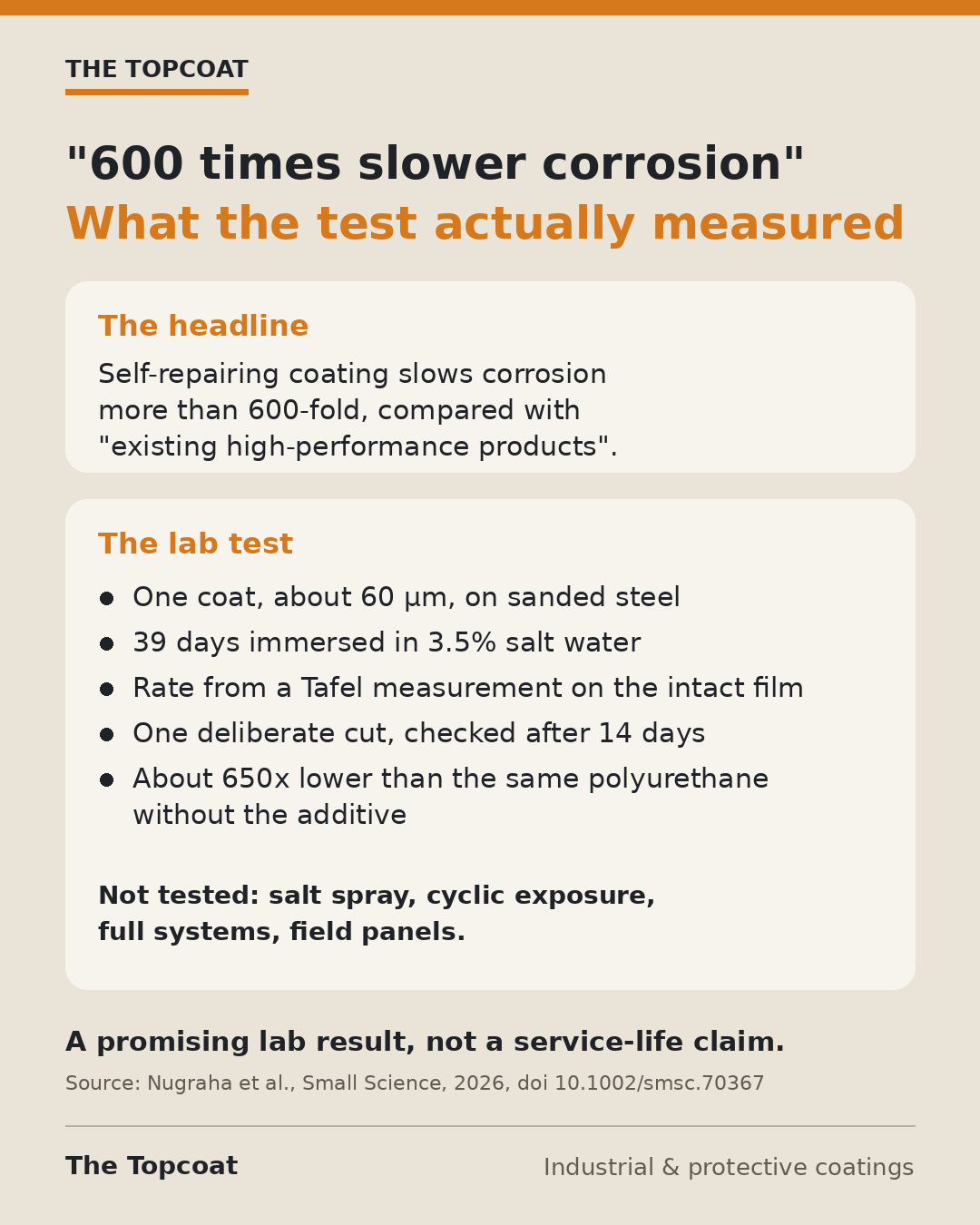
"Self-repairing coating slows corrosion more than 600-fold."
That headline went round in September. I read the paper behind it.
The work comes from the University of Queensland, published in Small Science (Nugraha et al., 2026). The chemistry is neat. Benzotriazole, a long-established corrosion inhibitor, is loaded into tiny porous containers and mixed into a waterborne polyurethane. When the pH at the steel shifts, the containers let more inhibitor out.
What was tested:
-
one coat, about 60 µm, on sanded steel panels
-
39 days immersed in 3.5% salt water
-
a corrosion rate converted from a Tafel measurement on the intact film
-
one deliberate cut, checked visually and under the microscope after 14 days
In that test, the modified coating's rate was roughly 650 times lower than the same polyurethane without the additive. That's the fair comparison. The press release set it against a generic figure for "existing high-performance products" instead.
So: a promising lab result for one thin coat. It says nothing yet about a full system in salt spray, cyclic testing or years outdoors. And "self-repairing" here means inhibitor released at the damage, not a film that closes up.
My own bar for any "smart coating" claim is simple: show me results from real use, in genuinely harsh conditions, not only from a beaker of salt water.
If you assess new coatings, what's the first piece of real-world evidence you ask for?
General information. The project specification and the product data sheet set the requirements for your job.