
The binder decides how a coating ages
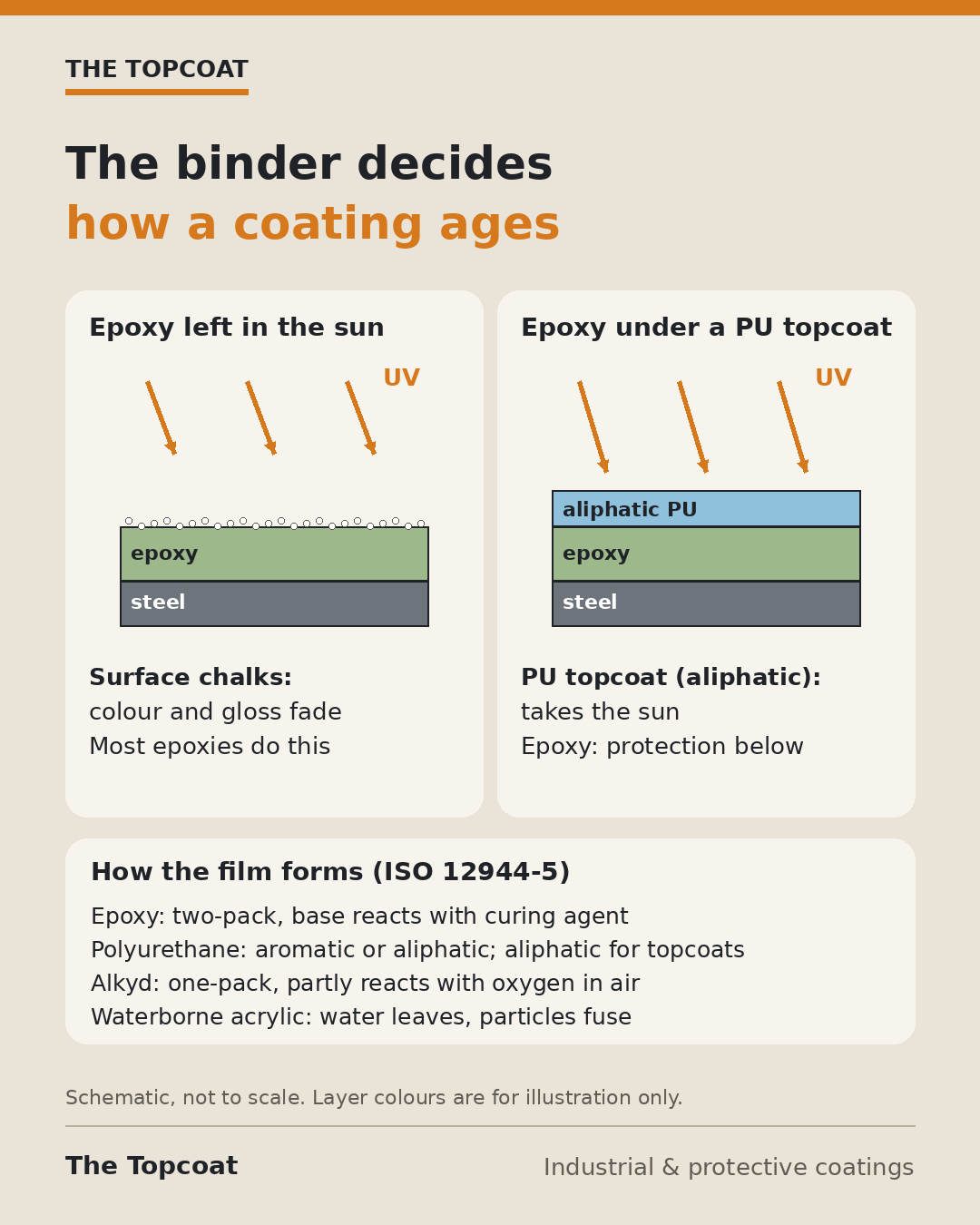
Why do so many steel specs put an epoxy underneath and a polyurethane on top?
Because of the binder.
The binder is the polymer that holds the film together and holds it onto the surface. Pigments, fillers and additives matter a lot, and two products with the same binder can perform very differently. But the binder decides two things before anything else: how the film forms, and how it ages.
ISO 12944-5 describes the generic types in a few lines each. Read them side by side and most of the logic of a coating system falls out:
-
Epoxy: two-pack, cures by a reaction between base and curing agent. Strong and well bonded, but most epoxies chalk in sunlight, and the standard says to add a suitable topcoat if colour or gloss retention matters.
-
Polyurethane: aromatic and aliphatic types. Only the aliphatic ones are recommended for topcoats, because the aromatic ones tend to chalk too.
-
Ethyl silicate zinc primer: cures by reacting with moisture from the air. The drier the air, the slower the cure. It is also sensitive to film thickness: too thick and it can crack.
-
Polysiloxane: part inorganic, part organic. Usually chosen as a topcoat where long colour and gloss retention matter.
-
Alkyd: one-pack, hardens partly by reacting with oxygen from the air.
-
Waterborne acrylic: the film forms as the water leaves and the particles fuse, and it can't be re-dissolved in water afterwards. A solvent-borne acrylic can be re-dissolved in its own solvent at any time.
Two practical points come out of that list.
First, every binder brings its own conditions. Epoxies slow down in the cold. Ethyl silicates need humidity. Waterborne films need the water to leave. The application window on the data sheet is the binder talking.
Second, the classic system isn't habit. The epoxy does the heavy lifting underneath, and the aliphatic PU or polysiloxane takes the sun.
The same logic travels to other substrates. An epoxy floor or wall coating on concrete will chalk or yellow where the sun hits it, for the same reason.
General information. The project specification and the product data sheet set the requirements for your job.