
Adhesive or cohesive failure? Read the dolly, not just the gauge.
Two pull-off tests can give the same number and very different news. On the first dolly the coating came away clean, and the bare substrate is looking back at you. On the second, a layer of concrete is still stuck to the underside of the coating.
The reading is half the result. The other half is where it broke.
-
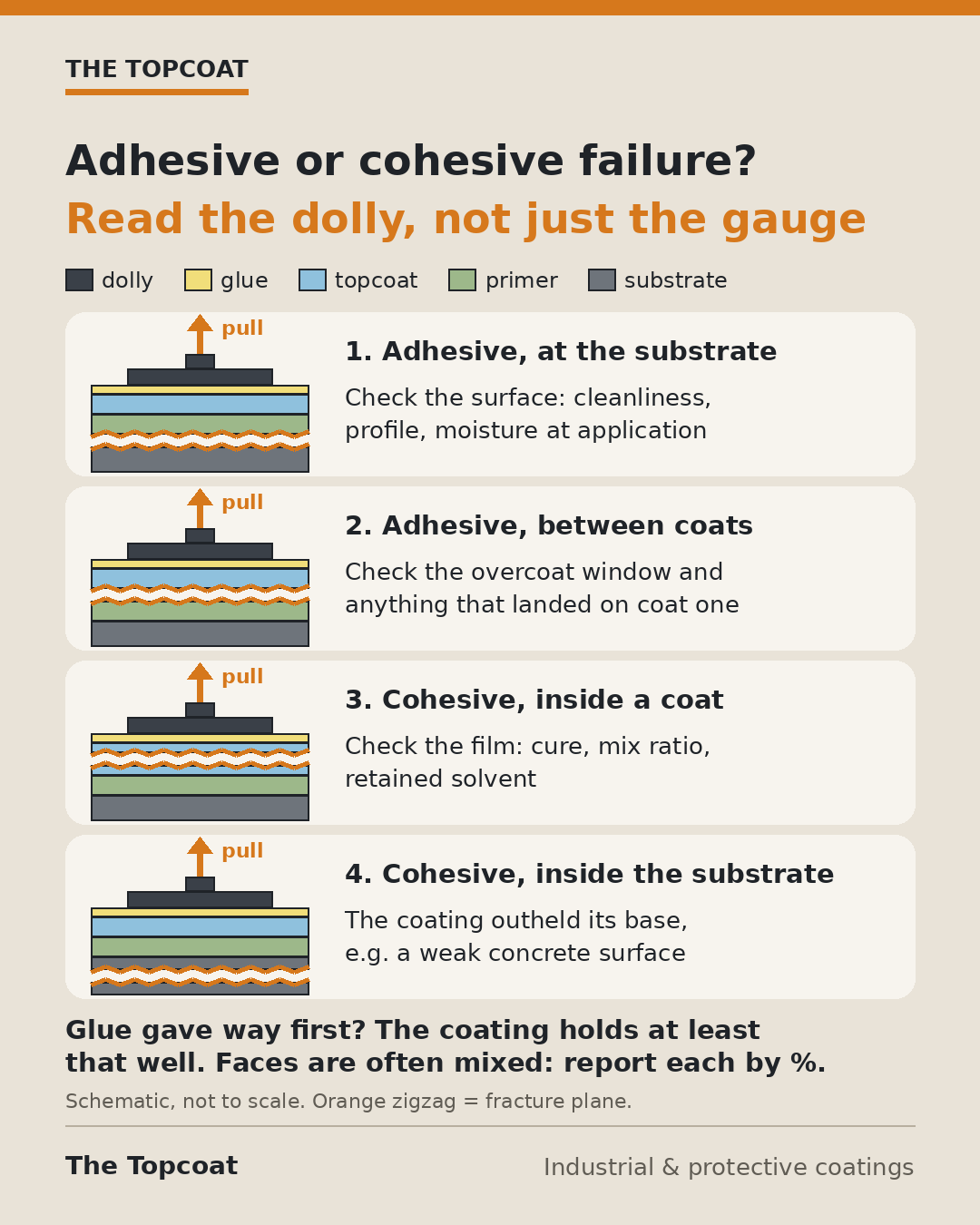
Adhesive failure: the break runs along an interface. Between substrate and first coat, I look at the surface first: contamination, profile, moisture at application. Between two coats, the overcoat window and whatever landed on the first coat.
-
Cohesive failure: the break runs through a material. Inside a coat, it points at the film itself, things like incomplete cure, wrong mix ratio or retained solvent. Inside the substrate, the coating outheld what it was stuck to. On concrete that's often a weak surface layer such as laitance. On wood, it can be the surface fibres.
-
Glue failure: the adhesive under the dolly gave up first. All you know is the coating holds at least that well.
Real fracture faces are often mixed, which is why ISO 4624 has you estimate each failure type as a percentage of the dolly area, to the nearest 10%. ASTM D4541 covers portable testers on metals, and ASTM D7234 is its counterpart for concrete. Your spec sets the pass value.
Does your inspection form have a box for the failure plane, or just the MPa?
General information. The project specification and the product data sheet set the requirements for your job.