
A clean blast can still fail. The problem is the salt you can't see
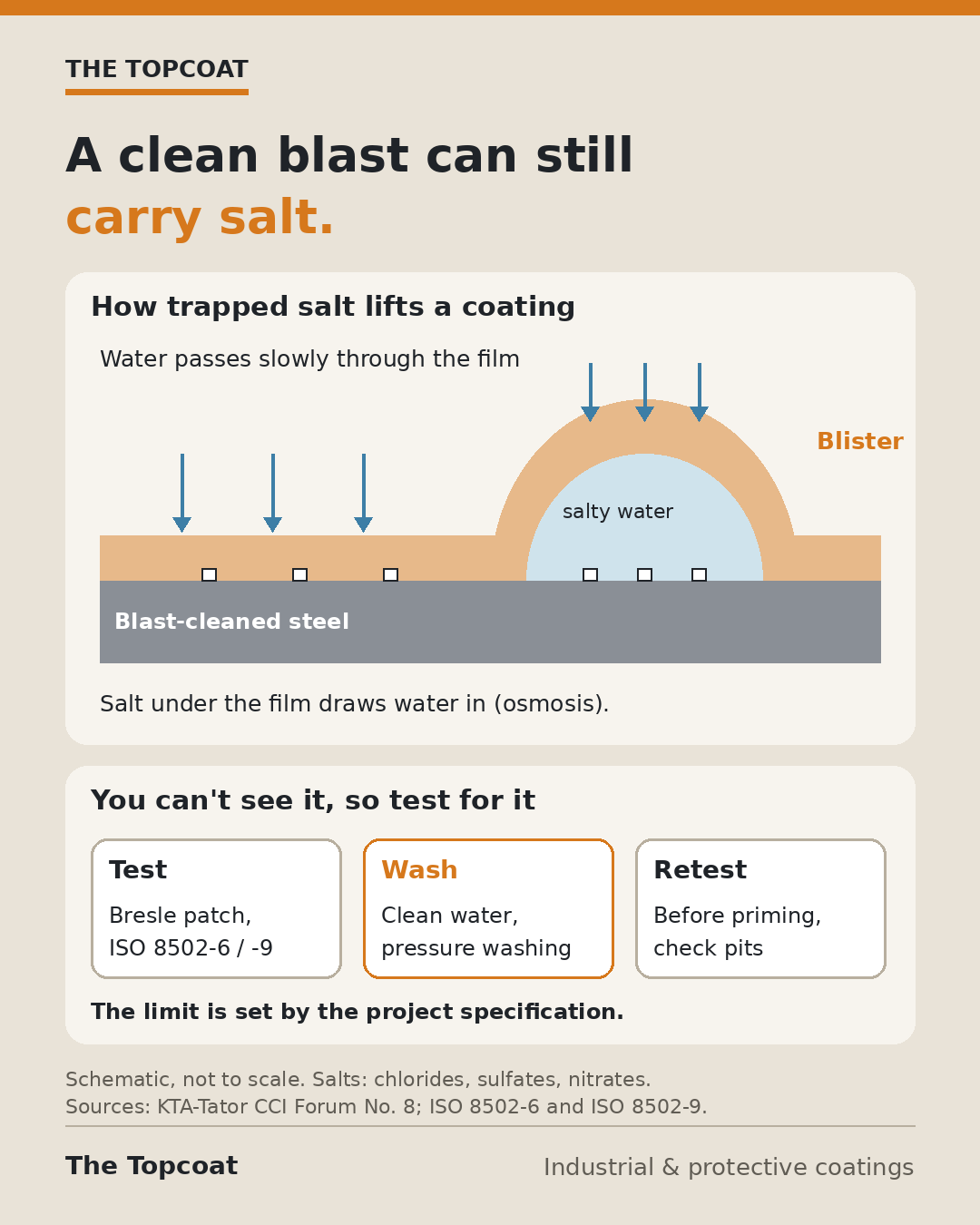
Blast-cleaned steel can look perfect: an even grey profile, no rust, no dust. The coating goes on to spec. A year later the surface is covered in blisters. Break one open and there's liquid and fresh rust underneath.
A common cause is soluble salts, mainly chlorides, sulfates and nitrates, left on the steel. You can't see them, and blasting alone doesn't reliably remove them.
Where they come from:
-
Sea air and de-icing salts on steel in service.
-
New steel stored or shipped in salty air.
-
Recycled abrasive that picked up salts from earlier jobs.
How a few micrograms lift a coating
No coating is a perfect barrier: water slowly passes through every film. When it reaches salt trapped under the coating, it dissolves the salt and makes a concentrated solution.
Water then keeps moving through the film towards that solution, from the dilute side to the concentrated side. That's osmosis. Pressure builds under the film and pushes it up into blisters, and the salty water underneath starts corrosion under the coating.
It's worst in immersion and other wet service, where there's always water to draw in. The same mechanism blisters floor coatings laid over salty concrete.
Why nobody notices
Blasted steel left uncoated overnight can show rust spots at pits, which is a warning sign. If it's primed straight away, the salts are sealed in and there's no visible sign at all.
How to find them
You have to sample the surface. The most common field method is the Bresle patch (ISO 8502-6): a small adhesive cell is stuck to the steel, pure water is injected, rubbed over the surface and drawn back out. Its conductivity is then measured (ISO 8502-9). There are also ion-specific tests for chloride, sulfate and nitrate.
How clean is clean enough?
There's no single industry-wide limit. Specifications range from "non-detectable" to tens of micrograms per square centimetre, depending on the salt and the service. The project specification sets the number. If it doesn't, ask before the job starts.
What fixes it
Washing, not more blasting. Pressure washing or water jetting with clean water dissolves the salts, and hot water works better than cold. Then test again before priming. Pits and crevices are the hardest places to clean, so test there.
On your jobs, is salt testing done every time, only for immersion, or only when the spec asks?
Sources: KTA-Tator, CCI Forum No. 8, "Surface soluble salt testing"; ISO 8502-6 and ISO 8502-9; SSPC Guide 15.
General information. The project specification and the product data sheet set the requirements for your job.