
Is the concrete dry enough to coat? What the moisture tests actually tell you
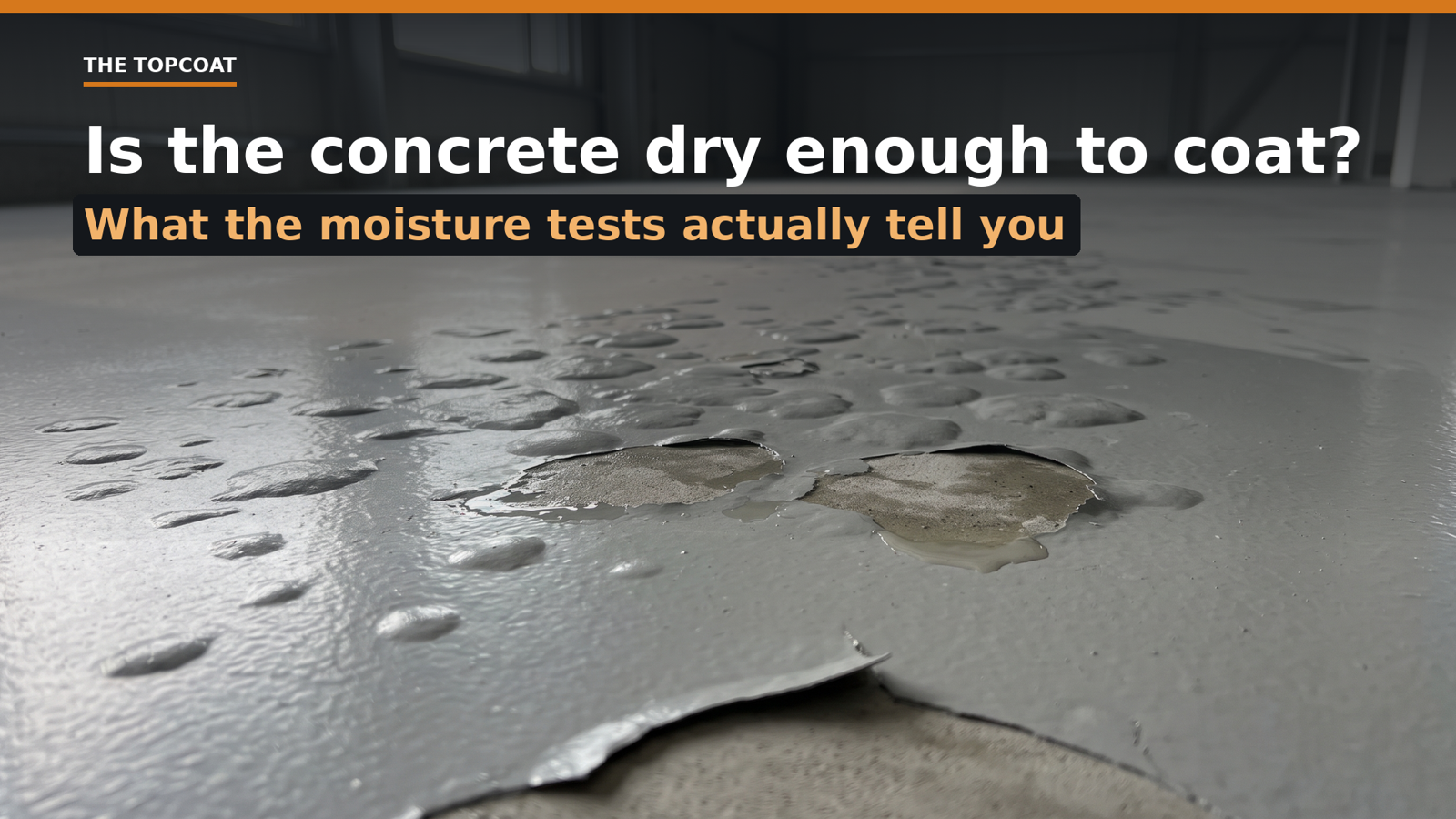
The floor coating looked fine on handover. A few weeks later there are blisters, some of them full of liquid, and the coating lifts in patches. The slab had been poured more than a month earlier. Everyone assumed it was dry.
Concrete moisture is one of the most common reasons coatings on floors fail, and one of the least understood. Part of the problem is that "dry" gets measured in three different ways, and each answers a different question.
The short answer
Age doesn't tell you moisture. A slab can be fully cured and still hold plenty of water.
The common tests measure different things. The plastic sheet test shows whether moisture is present at the surface. The calcium chloride test measures how much vapour leaves the surface. In-situ probes measure the relative humidity inside the slab.
The limit comes from the coating, not from the test. The data sheet or the specification names the method and the number. Compare like with like.
Why does moisture in concrete matter for a coating?
Concrete holds water in its pores and moves it towards the drier side, usually the top surface. A coating that slows that movement can end up with moisture building up underneath it. ASTM F2170, the in-situ relative humidity method, lists debonding and deterioration of coatings among the failures excess slab moisture can cause.
Moisture can also carry alkalinity to the interface, and not every binder tolerates that. And it's a different problem from the pinholes in my earlier post on outgassing, which come from air leaving a warming slab, not water.
What does a moisture failure look like?
The image at the top shows the typical pattern: blisters across the floor, some with liquid inside, and patches where the coating has let go of the concrete.
A few clues point to water coming up through the slab rather than another cause:
-
Blisters with liquid inside. If the liquid reads strongly alkaline on pH paper, it most likely came from the concrete.
-
A dark, damp concrete surface under a lifted patch, with little or no concrete stuck to the coating's underside. The bond failed at the interface, not inside the concrete. My earlier post on adhesive and cohesive failure covers how to read that.
-
White deposits at the interface. Water moving through concrete can carry dissolved salts and leave them where it stops.
-
A pattern that follows the slab. Worse near exterior walls, along pour joints, over thicker sections, or on a slab on the ground with no vapour barrier underneath.
None of these proves the cause on its own. Blistering and lifting can also come from contamination, poor preparation, or coating a surface that was cold and damp at the time. That's why the tests below belong before coating, not after the failure.
Isn't 28 days of curing enough?
Curing and drying are two different processes. Curing is the cement reacting with water and gaining strength. Drying is the extra water leaving the slab, and it can take much longer. How long depends on the slab's thickness, the mix, the temperature and humidity around it, and whether it can dry from one side or both.
In my view, a waiting period on its own is a starting point, not a test. If the coating is sensitive to moisture, measure.
What does each test actually tell you?
Figure 1 shows where each of the three common tests looks.
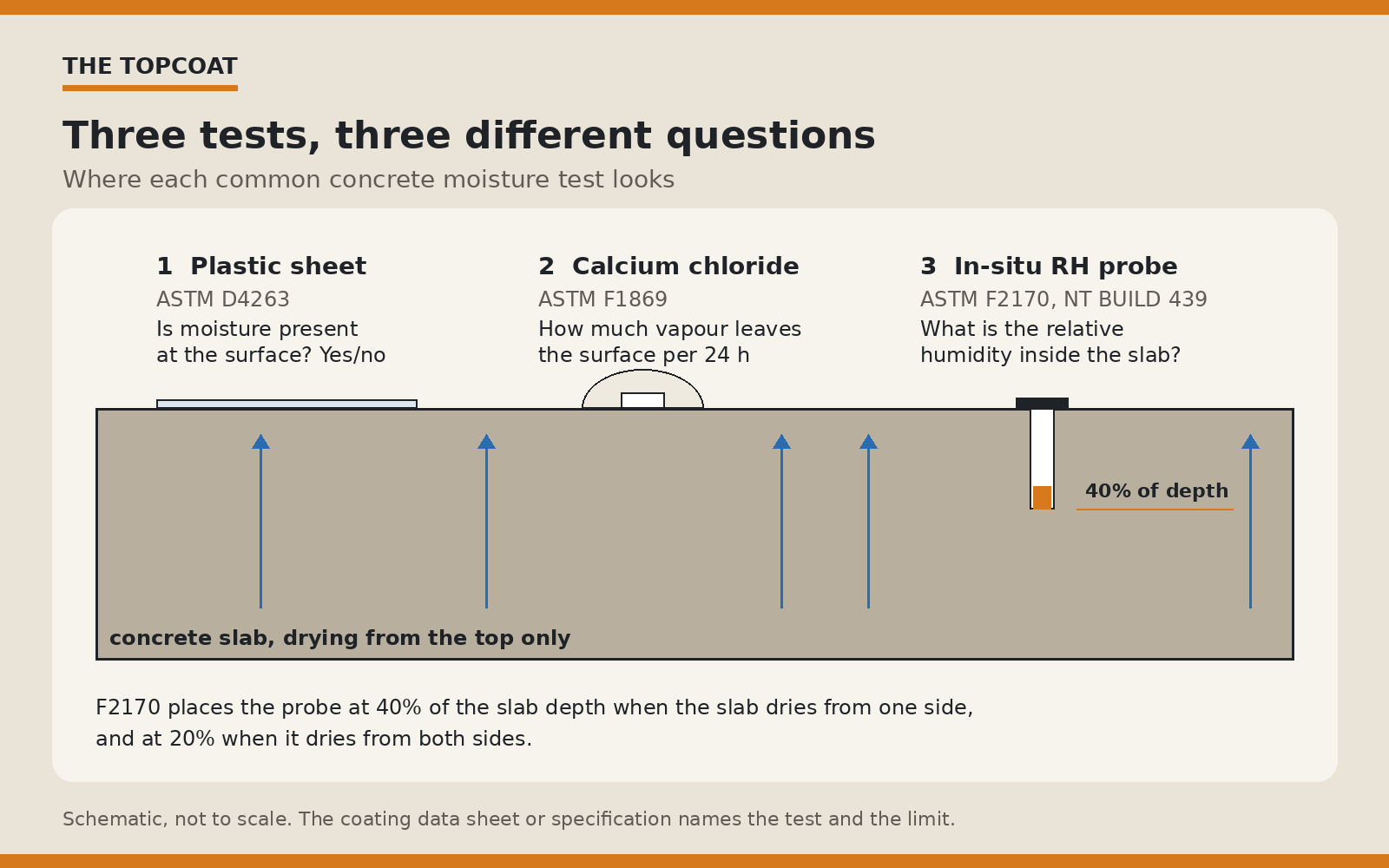
Figure 1. Where the plastic sheet, calcium chloride and in-situ relative humidity tests look in a slab that dries from the top. Schematic, not to scale.
The plastic sheet test. ASTM D4263 tapes a sheet of plastic to the surface for a set time and looks for signs of moisture underneath. It indicates whether capillary moisture is present. It gives no number. It's quick and cheap, which makes it useful for screening, but a pass doesn't prove the slab is dry.
The calcium chloride test. ASTM F1869 seals a dish of calcium chloride under a dome on bare concrete and weighs how much moisture it absorbs. The result is a moisture vapour emission rate, in pounds per 1,000 square feet per 24 hours. It's meant for bare slabs. It excludes lightweight aggregate and gypsum concrete, and it doesn't measure through existing coatings or patching compounds. It reflects what leaves the surface at the time of the test.
In-situ relative humidity probes. ASTM F2170 has you drill a hole, seal a probe in it and read the relative humidity inside the slab after an equilibration period. The probe goes to 40% of the slab depth when the slab dries from one side, and 20% when it dries from both. An update to the standard in 2018 allowed readings after 24 hours instead of 72.
Probe readings are sensitive to temperature, calibration and sensor drift. I'll come back to that below, because it changes how you should read a result close to the limit.
Which result do you compare with which limit?
This is where most mistakes happen. Figure 2 sums it up.
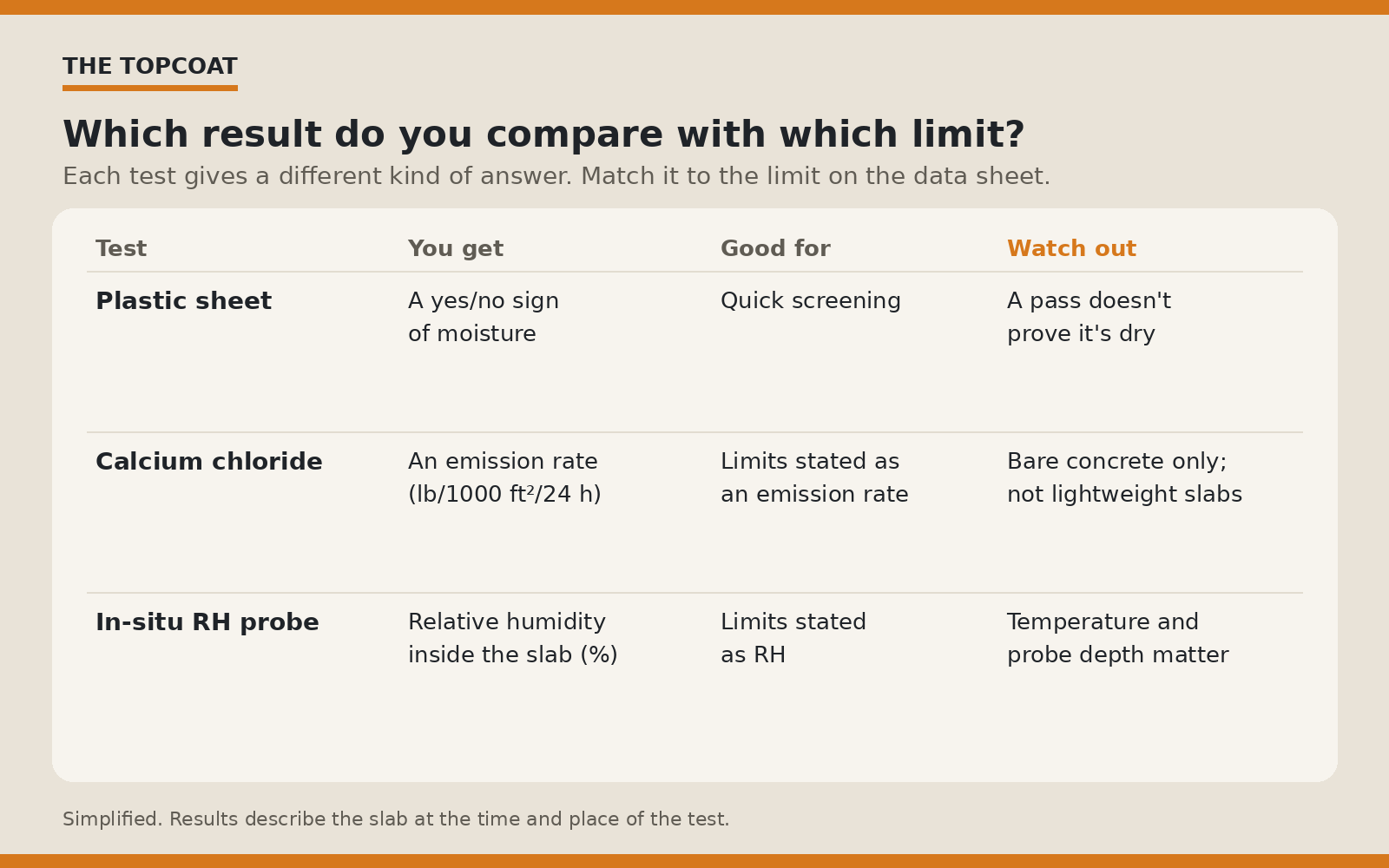
Figure 2. Each test gives a different kind of answer. Compare it only with a limit stated in the same terms.
-
Use the method the data sheet names. An emission rate and a relative humidity are different quantities. A limit stated in one doesn't translate neatly into the other.
-
Read the limit from the coating data sheet or the specification. The test standards tell you how to measure, not what's acceptable. F2170 itself notes that flooring manufacturers generally require moisture testing before installation.
-
Treat every result as a snapshot. F1869 and F2170 both say their results describe the slab only at the time of the test, and F2170 adds only at the locations tested. Test enough spots, and test again if conditions change.
How many tests, and where?
One reading is a data point, not a verdict. A slab doesn't dry evenly, and the wet spot is the one that matters.
How many. A widely quoted summary of ASTM F2170, from an instrument maker, gives three test locations for the first 1,000 square feet (about 93 m²) and one more for each additional 1,000 square feet. On that basis, a 10,000 ft² floor (about 930 m²) needs twelve. Check the edition your specification calls up, and use the specification's own count if it sets one.
Where. Spread the tests out, and put them where drying is likely to be slowest or uneven:
-
Near exterior walls. The same summary places probes within about 1 m (3 ft) of exterior walls, where water can get in, especially in slabs on the ground.
-
In each pour and each mix. Separate pours and different concrete mixes dry at different rates.
-
Where conditions differ. Areas in sun, in a draught or near heaters dry differently from the rest. So do thicker sections.
-
Where you'd least like a failure. Under heavy equipment, at drains, at the areas that will see the most traffic.
Figure 3 shows a simple layout.
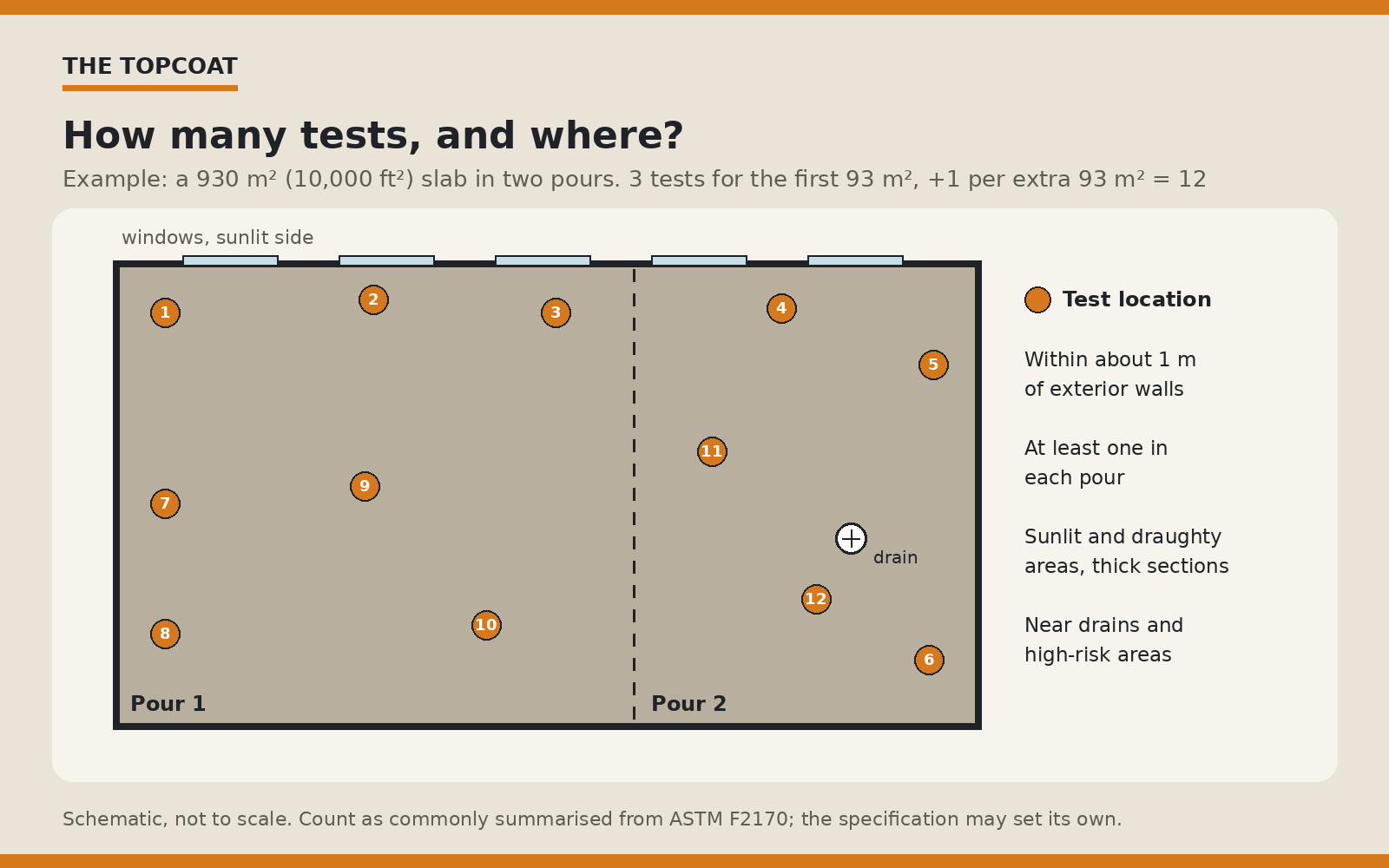
Figure 3. An example layout of test locations on a slab, following the count in a common summary of ASTM F2170. Schematic, not to scale. The specification may set its own count.
Record everything. Location, depth, slab and air temperature, humidity, time, and the instrument used. A reading without that context is hard to defend later.
How do the Nordic countries do it?
Sweden has one of the most developed systems for this, and it's worth knowing even if you never work there.
Relative humidity replaced older methods. Measuring relative humidity was proposed in Sweden in the late 1970s to replace the older carbide (CM) method, and since 1984 it has been the main way to check concrete floors before moisture-sensitive coverings go down. In my view the reason is simple: relative humidity is the quantity a coating or floor covering actually responds to.
The measurement is a qualification, not a gadget. Since 1999, Sweden's RBK scheme has authorised moisture inspectors for concrete. They pass a knowledge test, follow a common manual, use approved instruments and are audited. Clients are advised to hire an authorised inspector.
Two methods, with known uncertainty. The Swedish system uses a borehole method and a method where a sample is removed and measured in a tube. Material from Lund University puts their uncertainty at about ±3% and ±2% relative humidity respectively, with the reading taken at an equivalent depth of 40% of the slab thickness. The same material shows a reading shifting by up to about 0.4% relative humidity per degree of temperature difference. The Nordtest method NT BUILD 439 describes the drilled-hole measurement for the wider Nordic region.
Why this matters outside Scandinavia. If a measurement carries ±2-3% uncertainty, a reading 1% under the limit isn't a clear pass. In my view the Swedish approach gets three things right that travel anywhere: trained people, one agreed method, and an honest number for the uncertainty.
What if the slab is too wet?
You have three broad options:
-
Wait and dry it. Heating and ventilation help, but drying a thick slab takes time.
-
Choose a system designed for damp concrete. Some primers and coatings are formulated to tolerate higher moisture, or to act as a moisture barrier under the rest of the system. The data sheet should say so explicitly. If it doesn't, I'd assume it isn't.
-
Choose a more vapour-permeable system, where the use allows it. EN 1504-2 frames the different kinds of surface protection for concrete, and permeability is one of the properties that separates them.
SSPC-SP 13/NACE No. 6, the AMPP standard on preparing concrete for coating, includes dryness among its requirements alongside cleanliness, strength and surface profile. Moisture isn't an afterthought. It's part of surface preparation.
Before you coat a slab
-
Find which moisture test and which limit the data sheet or specification asks for.
-
Test with that method, at enough locations (Figure 3), under conditions close to service.
-
Treat a reading just under the limit as a borderline result, not a pass.
-
Record the slab and air temperature and humidity with each reading.
-
Don't swap a relative humidity result for an emission rate, or the other way round.
-
Check the surface itself too. Condensation on a cold slab is still possible, as covered in my article on dew point.
Which moisture test do you see used most on site, and do you trust it? I'd like to hear it in the comments.
This article is general information. The project specification and the product data sheet set the test method and the limit for your job.
Written by a PhD chemical engineer leading R&D in protective coatings. Views are the author's own.
Sources
- ASTM D4263-24, Standard Practice for Indicating Moisture in Concrete by the Plastic Sheet Method: https://store.astm.org/d4263-24.html
- ASTM F1869-23, Standard Test Method for Measuring Moisture Vapor Emission Rate of Concrete Subfloor Using Anhydrous Calcium Chloride: https://store.astm.org/f1869-23.html
- ASTM F2170, Standard Test Method for Determining Relative Humidity in Concrete Floor Slabs Using in situ Probes (current edition not stated): https://store.astm.org/f2170-19.html
- Daniel K., "Changes to concrete standards: how they clarify your choice of test methods", The Construction Specifier, 4 May 2018: https://www.constructionspecifier.com/changes-to-concrete-standards-how-they-clarify-choice-of-test-methods/2/
- Spangler J., "Does it matter how many concrete moisture tests I use?", Wagner Meters (instrument maker), 26 May 2020: https://wagnermeters.com/concrete-moisture-test/concrete-info/proper-number-of-tests-for-concrete
- RBK, Manual: Fuktmätning i betong, version 5 (2010), summarised in SBUF information sheet 1101: https://vpp.sbuf.se/Public/Documents/InfoSheets/PublishedInfoSheet/128e3e3f-8329-480d-988d-8a84a1fcb1a7/SBUF_1101.pdf
- Sjöberg A., Fuktmätning i betonggolv (slides), Lund University / FuktCentrum, ScandBuild, 31 March 2009: https://www.fuktcentrum.lth.se/fileadmin/fuktcentrum/PDF-filer/INFOdagar/Infodag_Lund/Infodag200903ScandBuild/AS_Fuktmaetning_i_betonggolv.pdf
- Nordtest, NT BUILD 439, Concrete, hardened: relative humidity measured in drilled holes (1995): https://www.nordtest.info/wp/?p=871
- Nilsson L.-O., Åhs M., "Methods for measuring relative humidity (RH) in concrete floors: development and uncertainties", Aquametry 2010, pp. 406-413: https://www.lunduniversity.lu.se/lup/publication/6bb2a260-b4a7-4f5b-afc0-a8fd006e68f9
- SSPC-SP 13/NACE No. 6-2024, Surface Preparation of Concrete (AMPP): https://store.ampp.org/sspc-sp-13-nace-no-6-2024-surface-preparation-of-concrete
- Saricimen H. et al., "Blistering of epoxy coating on concrete floor", King Fahd University of Petroleum and Minerals (case investigation 1995), pp. 288-297: https://eprints.kfupm.edu.sa/id/eprint/1791/1/288-297_BLISTERING_OF_EPOXY_COATING_ON_CONCRETE_FLOOR.PDF
- Ignoul S., Van Rickstal F., Van Gemert D., "Blistering of epoxy industrial floor on concrete substrate: phenomena and case study", KU Leuven (about 2004): https://bwk.kuleuven.be/mat/publications/internationalconference/2004-ignoul-blistering-icpic.pdf
- EN 1504-2, Products and systems for the protection and repair of concrete structures, Part 2: Surface protection systems for concrete (edition not stated)