
Dew point and surface temperature: what the 3 °C rule covers, and what it doesn't
It's a cold, clear morning. The blast-cleaned steel looks dry and feels dry. The air isn't especially humid. And there's still a film of water on it that nobody can see.
That's the problem the dew point check exists for. Most coating people know the rule: keep the steel at least 3 °C above the dew point. Fewer know where it comes from, when it applies, and where it stops being useful. This article covers all three.
The short answer
The 3 °C rule is a steel rule. It keeps condensation off the surface while you prepare, apply and cure a coating.
It's a widely used margin, not a universal requirement. Your project specification and the product data sheet set the actual limit.
On wood, concrete and plastics, "dry enough" is a different question and needs a different check.
What is the dew point, and why does steel care?
The dew point is the temperature at which the air is saturated with water vapour. If a surface sits at or below it, water condenses on that surface. Air at 10 °C and 80% relative humidity, for example, has a dew point of about 6.7 °C.
Steel is good at getting there. It conducts heat well and holds a lot of it, so a heavy section can stay cold long after the air has warmed up. On a clear night it can also cool below air temperature. The result is a surface that can be wet when the air itself feels fine.
Condensation on steel is usually too thin to see. Coat over it and you put the coating onto water instead of onto steel. On blast-cleaned steel it can also start flash rusting within a short time.
Where does the 3 °C rule come from?
It's written into a lot of specifications and inspection documents. The FHWA Field Manual for Bridge Painting Inspection, for example, has a line on its inspection form saying steel surface temperature should be a minimum of 3 °C (5 °F) above dew point. It leaves the humidity and temperature limits blank for the project specification to fill in.
ISO 8502-4 gives guidance on estimating the probability of condensation before painting steel. It's guidance, not a pass/fail requirement. ASTM D3276, the guide for painting inspectors on metal substrates, covers weather conditions and humidity and dew point measurement. SSPC-PA 1 is also often cited for the same margin.
Why 3 °C and not zero? One instrument maker explains that the margin also allows for the surface cooling as solvents evaporate. In my view it also covers ordinary measurement uncertainty: a surface reading is never exact, and it changes across a structure.
When does it apply?
Before, during and after application. The surface has to stay above the margin while you prepare it, while you apply the coating, and until the coating has dried enough. Specifications word the end point differently, so check yours.
That's why inspection practice is to check conditions before work starts and again at intervals during the shift. The FHWA form asks for a check before starting and every four hours. Conditions change quickly in the evening, so I'd check more often then.
Figure 1 shows something people often miss. If the steel is at air temperature, it stays outside the 3 °C margin only up to roughly 82-83% relative humidity, whether the air is 10 °C or 20 °C. Above that, steel at air temperature is already too close to the dew point. Steel colder than the air hits the limit sooner. It also helps explain why many specifications add a maximum relative humidity alongside the dew point check.
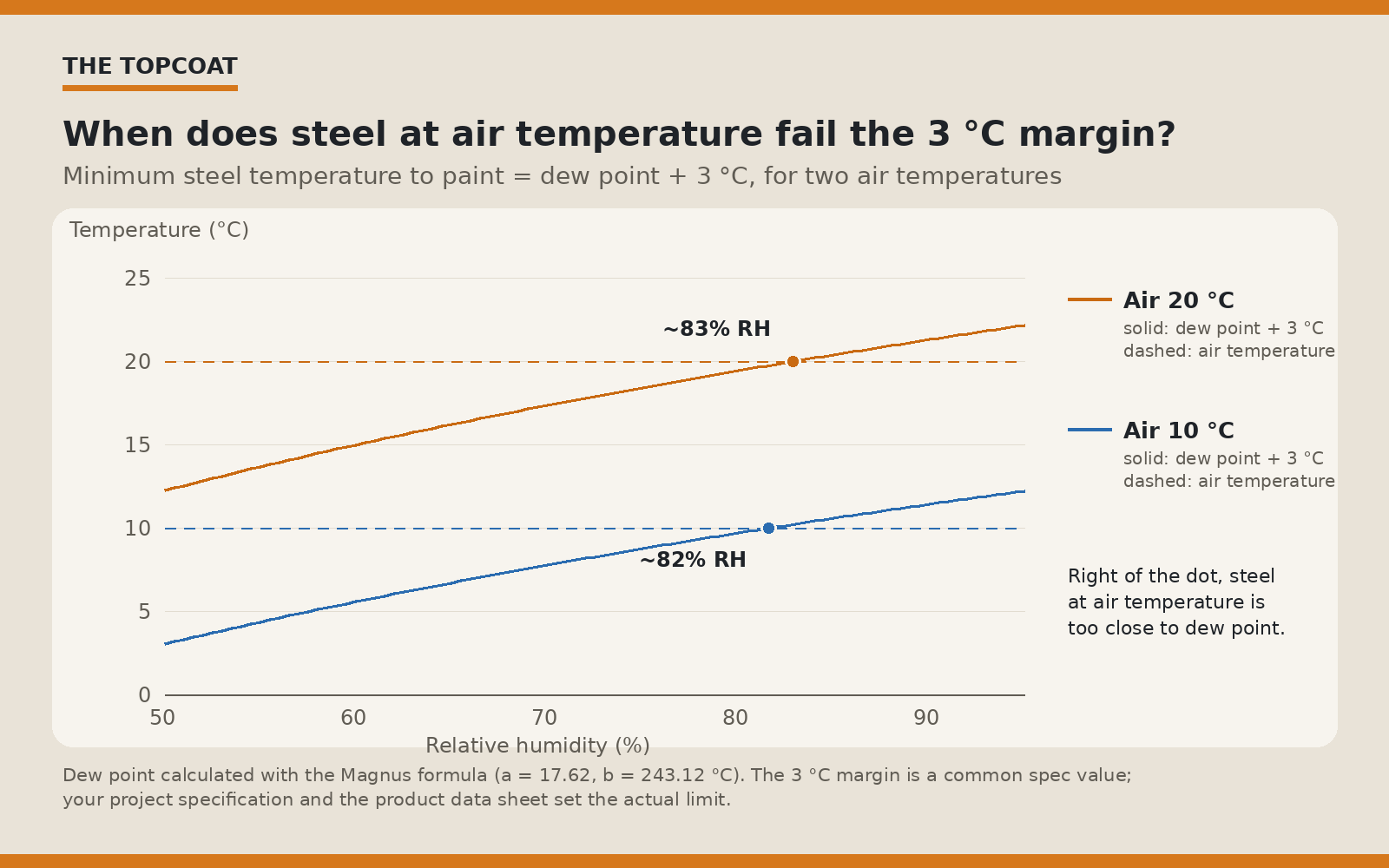
Figure 1. Minimum steel temperature for painting (dew point + 3 °C) against relative humidity, for air at 10 °C and 20 °C. Dew point calculated with the Magnus formula. Your specification and the data sheet set the actual limit.
How do you measure surface temperature properly?
The rule is only as good as the reading. A few habits make a big difference:
-
Measure the steel, not the air. Use a contact surface thermometer or a probe on the surface. An air thermometer tells you nothing about the steel.
-
Let the instrument settle. Contact thermometers need a couple of minutes to stabilise. Keep them out of direct sun, wind and heat sources.
-
Be careful with infrared thermometers. The further you stand from the surface, the larger the area you're measuring, and the less your reading tells you about one spot.
-
Measure where it's coldest. That usually means the shaded side, the heaviest sections and anything in contact with the ground or cold water.
-
Write it down. Air temperature, relative humidity, dew point and steel temperature, with times. If something fails later, that record is what everyone will ask for.
What the rule doesn't cover
It doesn't cover water that isn't condensation. Rain, run-off, leaks and water held in pits or crevices are a separate problem. A dew point reading won't find them.
It doesn't cover salts. Soluble salts left on the surface attract moisture even when the steel is above the dew point. That's why salt contamination checks (for example ISO 8502-6 and ISO 8502-9) exist alongside the dew point check.
It doesn't replace the data sheet. Some products have their own limits on humidity and temperature, and some cure chemistries actually need moisture from the air. The data sheet and the specification win.
It doesn't transfer to other substrates. That's the next section.
What about wood, concrete and plastics?
The physics of condensation is the same on any cold surface. But on porous substrates, the bigger question is usually the water already inside the material, and a dew point reading tells you nothing about that. Figure 2 sums up the difference.
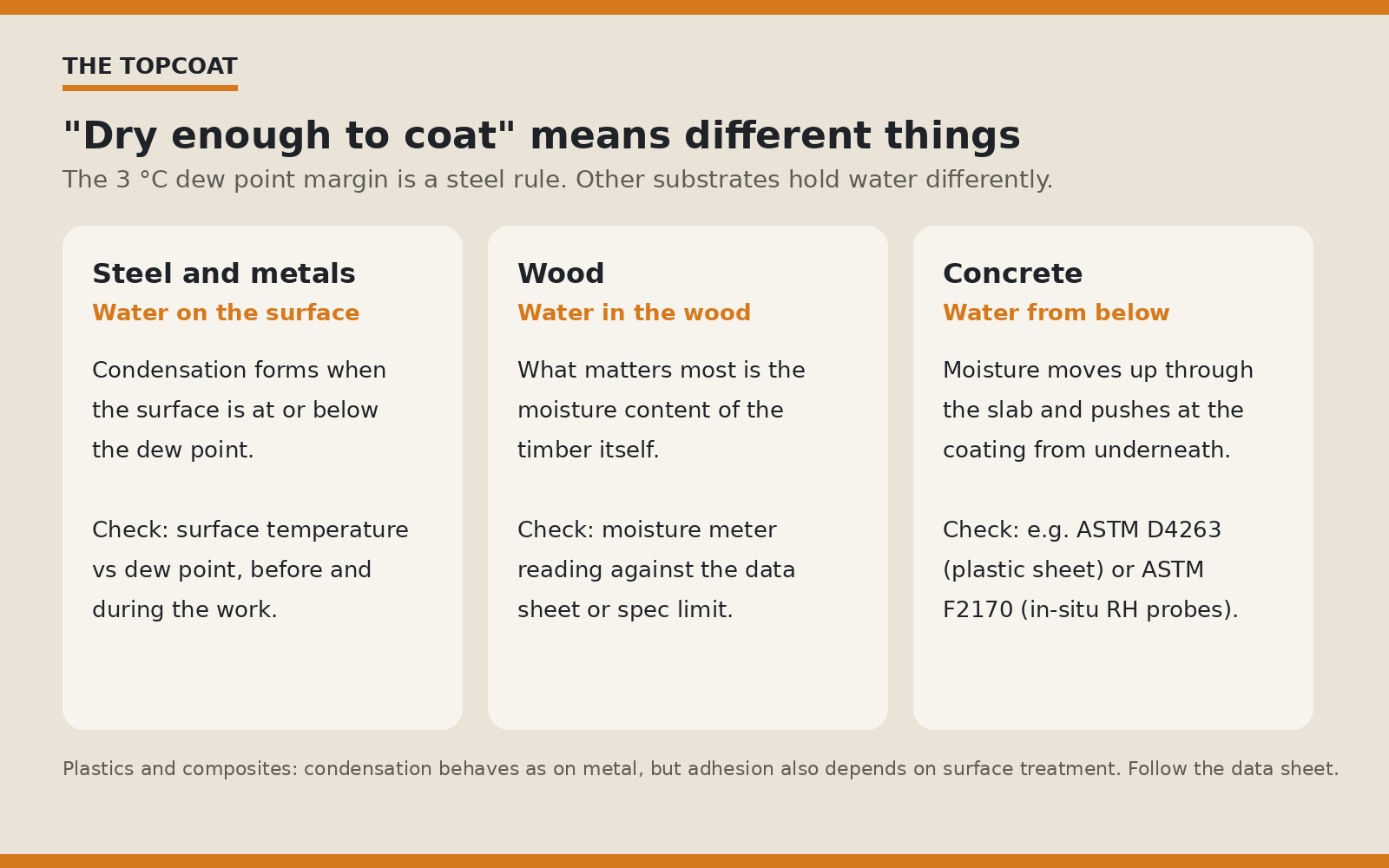
Figure 2. What "dry enough to coat" means on steel, wood and concrete, and the check that goes with each.
Wood. What matters most is the moisture content of the timber. The USDA Forest Service handbook Finishing Wood Exteriors says blistering and peeling are likely if wood is painted above 20% moisture content. It also advises painting when the moisture content is close to what the wood will see in service. That handbook is old and written for North America, so check current guidance and the data sheet for your product and climate.
Concrete. Moisture moves up through a slab and pushes at the coating from underneath. ASTM D4263, the plastic sheet method, indicates whether capillary moisture is present. ASTM F2170 measures relative humidity inside the slab with in-situ probes, and gives a number to compare against a limit. SSPC-SP 13/NACE No. 6 includes dryness among its requirements for preparing concrete. Temperature still matters too: a slab that's warming up can push air out through a fresh coating and leave pinholes, which I wrote about in an earlier post.
Plastics and composites. These don't absorb much water, so condensation behaves much as it does on metal. Adhesion depends heavily on surface treatment, though, so the data sheet's preparation and condition limits are the reference.
A short checklist before you open the first can
-
Find the limit in the specification and the data sheet. Don't assume 3 °C.
-
Measure the surface itself, at its coldest point.
-
Calculate the dew point from air temperature and relative humidity, or read it from a meter.
-
Check again during the work and until the coating is dry, more often as evening comes.
-
On wood or concrete, also check the moisture in the substrate.
If I could give every new inspector and applicator one habit, it would be this: put the thermometer on the steel, at its coldest spot, and write the reading down. Every time, not only when the surface looks damp. The days that cause trouble are the ones when it looks dry.
Where on a structure have you seen surface temperature readings go most wrong? I'd like to hear it in the comments.
This article is general information. The project specification and the product data sheet set the limits for your job.
Written by a PhD chemical engineer leading R&D in protective coatings. Views are the author's own.
Sources
- FHWA, Field Manual for Bridge Painting Inspection, FHWA-RD-98-084, painting section: https://www.fhwa.dot.gov/publications/research/infrastructure/structures/98084/paintinga.cfm
- ISO 8502-4:2017, Preparation of steel substrates before application of paints and related products, Part 4: Guidance on the estimation of the probability of condensation prior to paint application: https://www.iso.org/standard/58061.html
- ASTM D3276-21, Standard Guide for Painting Inspectors (Metal Substrates): https://store.astm.org/d3276-21.html
- DeFelsko, Measuring environmental conditions: https://www.defelsko.com/resources/measuring-environmental-conditions
- Cassens D.L., Feist W.C., Finishing Wood Exteriors: Selection, Application, and Maintenance, USDA Forest Service Agriculture Handbook 647, 1986: https://www.fpl.fs.usda.gov/documnts/usda/ah647.pdf
- ASTM D4263-24, Standard Practice for Indicating Moisture in Concrete by the Plastic Sheet Method: https://store.astm.org/d4263-24.html
- ASTM F2170, Standard Test Method for Determining Relative Humidity in Concrete Floor Slabs Using in situ Probes: https://store.astm.org/f2170-19.html
- SSPC-SP 13/NACE No. 6-2024, Surface Preparation of Concrete (AMPP): https://store.ampp.org/sspc-sp-13-nace-no-6-2024-surface-preparation-of-concrete
- Dew point values in this article and chart are calculated with the Magnus formula (a = 17.62, b = 243.12 °C).